This World Water Week, explore how water access shapes pastoral livelihoods, migration routes and resilience across India’s changing landscapes.
A Better Tomorrow
Stories, Practices, and Solutions
Pastoralism has shaped India’s rangelands for centuries. Here’s why pastoralists are key to protecting biodiversity and healthy ecosystems.
वैज्ञानिक बकरीशेड और WOTR के प्रशिक्षण ने सुमन सिंह की जिंदगी बदल दी। उनके दृढ़ संकल्प ने संघर्ष को आजीविका के एक टिकाऊ ग्रामीण स्रोत में बदल दिया।
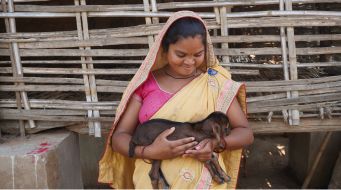
Goat rearing changed Suman Singh’s fortunes with scientific shed design and, WOTR training. Her grit turned struggle into sustainable rural income.
The Rabi Jal Pehal project brought trained Pashusakhis to Agarbatti’s doorstep, offering affordable livestock care and practical guidance.
Exploring village-based systems through Ecosystem-based Adaptation (EbA) offers promising, sustainable solutions for the livestock sector.
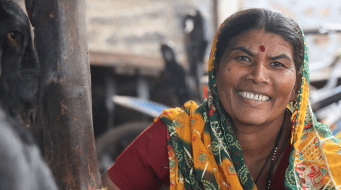
Sunita Jadhav from Bhandar Kumtha village, once struggling with daily wages, found new hope through goat rearing with support from Wells Fargo and WOTR. This venture provided her family financial stability, allowing her to earn a significant income and construct a shed for the goats’ safety.
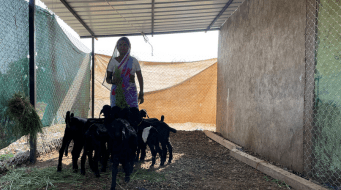
Babai Sahadev Selhar, aged 52, and her family, long-time traditional goat rearers in Beed, faced mounting challenges in recent years. Residing adjacent to a forest, their livelihood was threatened by persistent wild animal attacks, resulting in a significant loss of income, nearly a third of their total earnings. In response, Selhar was graciously provided with a goatshed by WOTR, facilitated through the Axis Bank Foundation’s ‘Sustainable Livelihood Programme in Maharashtra’.
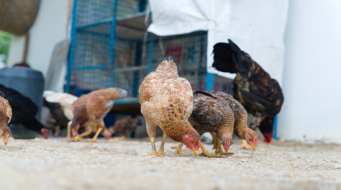
A large majority of the families in Narayanpet, Telangana are either wage labourers or small and marginal farmers who own less than 1Ha. of land. They have meagre incomes, limited access to resources, and no additional skill or financial support available to generate an alternate income. Keeping these factors in mind, the families were given support with backyard poultry farming.
This blog delves into the lives of the Changpa community, a near-invisible pastoral nomadic community in Ladakh and a group largely unknown to mainstream society.
This World Water Week, explore how water access shapes pastoral livelihoods, migration routes and resilience across India’s changing landscapes.
Pastoralism has shaped India’s rangelands for centuries. Here’s why pastoralists are key to protecting biodiversity and healthy ecosystems.
वैज्ञानिक बकरीशेड और WOTR के प्रशिक्षण ने सुमन सिंह की जिंदगी बदल दी। उनके दृढ़ संकल्प ने संघर्ष को आजीविका के एक टिकाऊ ग्रामीण स्रोत में बदल दिया।
Goat rearing changed Suman Singh’s fortunes with scientific shed design and, WOTR training. Her grit turned struggle into sustainable rural income.
The Rabi Jal Pehal project brought trained Pashusakhis to Agarbatti’s doorstep, offering affordable livestock care and practical guidance.
Exploring village-based systems through Ecosystem-based Adaptation (EbA) offers promising, sustainable solutions for the livestock sector.
Sunita Jadhav from Bhandar Kumtha village, once struggling with daily wages, found new hope through goat rearing with support from Wells Fargo and WOTR. This venture provided her family financial stability, allowing her to earn a significant income and construct a shed for the goats’ safety.
Babai Sahadev Selhar, aged 52, and her family, long-time traditional goat rearers in Beed, faced mounting challenges in recent years. Residing adjacent to a forest, their livelihood was threatened by persistent wild animal attacks, resulting in a significant loss of income, nearly a third of their total earnings. In response, Selhar was graciously provided with a goatshed by WOTR, facilitated through the Axis Bank Foundation’s ‘Sustainable Livelihood Programme in Maharashtra’.
A large majority of the families in Narayanpet, Telangana are either wage labourers or small and marginal farmers who own less than 1Ha. of land. They have meagre incomes, limited access to resources, and no additional skill or financial support available to generate an alternate income. Keeping these factors in mind, the families were given support with backyard poultry farming.
This blog delves into the lives of the Changpa community, a near-invisible pastoral nomadic community in Ladakh and a group largely unknown to mainstream society.
By Categories
By Tags
Water Budgeting in Yeniye Khurd assesses water availability, demand, and agricultural needs, revealing a deficit and guiding community-led planning for resilience.
At an FPO meeting, a woman’s presence can be easy to count. She is a member. Her name may appear on the board. What is harder to see is what that presence means in practice.
A walkthrough of how WOTR is enabling farmers in Maharashtra’s Marathwada region prepare for an increasingly unpredictable climate.
From aspiring government teacher to community leader, Mahaveer journey shows how community mobilisation, leadership and collective action can transform rural development in Rajasthan.
Group irrigation wells reveal how shared water resources can strengthen livelihoods, support year-round farming, and prepare for climate uncertainty.
It is a small enterprise, still finding its feet. But its beginnings are firmly local, shaped by what the women know, what the farmers need and what the village already has.
Bringing light, safety, and renewed community life to 20 villages in Kabirdham through 150 solar streetlights, empowering communities to reclaim their public spaces.
How planning and implementation of ecosystem-based adaptation (EbA) and agroecology principles in arid or semi-arid regions can help address the growing impacts of climate change.