Category: Climate Change Adaptation

Participatory vulnerability assessment

In the month of April 2017, our team visited Padmavati village in Bhokardan block of Jalna district, Maharashtra to carry out a community driven vulnerability assessment study.

Different stakeholders from the village were invited to participate in focus group discussions to share the major changes that had been observed over the years.

Read More »
Chhattisgarh

Community Driven Vulnerability Evaluation-Program designer : An Introduction

WOTR developed a tool called Community Driven Vulnerability Evaluation-Programme Designer (CoDriVE-PD) that clearly identifies the need to factor in an evaluation of all such key vulnerabilities at an early stage in the project design and subsequently integrate these variables within the project framework, so as to minimize adverse impacts and thus, have better control of the project and the achievement of desired outcomes.

Read More »

Field musings on the rise of farm ponds and its impact on the common pool groundwater resource.

Farm ponds are being set up to provide protective irrigation so as to secure a second crop and provide water during lean summer months. In Maharashtra, the government has announced schemes to drought proof their land and encourage farmers to construct farm ponds. But is the rise of these structures  in the semi-arid regions of Maharashtra creating inequity in the share of groundwater among farm groups? The following blog post , written by our researcher for the Adaptation in Scale in Semi Arid Regions (ASSAR)  blog highlights the urgent need to rethink on the collective  use of the invisible common pool resource for preventing drought in the long run.

Read More »
Water & Land

Improving Soil Health for Enhancing Food and Nutritional Security

WOTR conducted a study to understand the current status of land degradation, its causes, farm management practices employed by people and the perceived impacts of the varying climatic conditions. The study was conducted in 21 villages spread across three districts in Maharashtra- Ahmednagar, Dhule and Jalna. Ten percent farmer households from these villages were interviewed.

Read More »

Under the blazing sun

The short film “Under the Blazing Sun” was shot during the summers of 2016 and 2017 in two semi- arid districts of Maharashtra in India. The film attempts to explore the problem of heat stress experienced by rural communities. While urban population is better equipped to tackle the heat problem, is that the case with the rural population? If yes how? If not then, what are their problems?

Read More »

Deteriorating Groundwater – Is this an irrevocable process?

Our perceptions and plans to address issues revolving around our water resources need to adapt if we are to respond effectively to the challenge of climate change. Most of our surface water bodies and aquifers are stressed not just in terms of availability of water but also at the quality front. The reasons can be attributed to changes in the timing, form and intensity of precipitation; changes in agricultural practices, urbanisation, industrial pollution and the use of surface and groundwater . It has the potential to have a long lasting impact on various ecosystems and their services that we are completely dependent on. The impacts are likely to affect the ongoing and future programs designed to protect water quality, public health, safety and livelihood of people. With this in mind, WOTR’s Groundwater and Ecology team continued to explore villages in their second leg of Mula-Pravara sub-basinal seasonal study to assess the reasons for the declining water quality.

Read More »
Ecosystem-based Adaptation for Water Security

Adaptation to climate change: What has social structure got to do with it?

While some may doubt and even deny the existence of climate change, rural households in three villages of Aurangabad District in Maharashtra State, India will tell you it is a reality and a daily battle. Climate change also doesn’t act alone – it has two other accomplices – non-climatic risks and coping strategies. In India these accomplices are shaped by historic and structural factors such as caste, gender, local politics and so on, which determine adaptation or maladaptation. In this blog we look at what different caste groups are doing in response to climate change and what has driven them to adopt these practices.

Read More »
Agriculture

A nudge in the right direction: Using agro-advisories to encourage sustainable agriculture

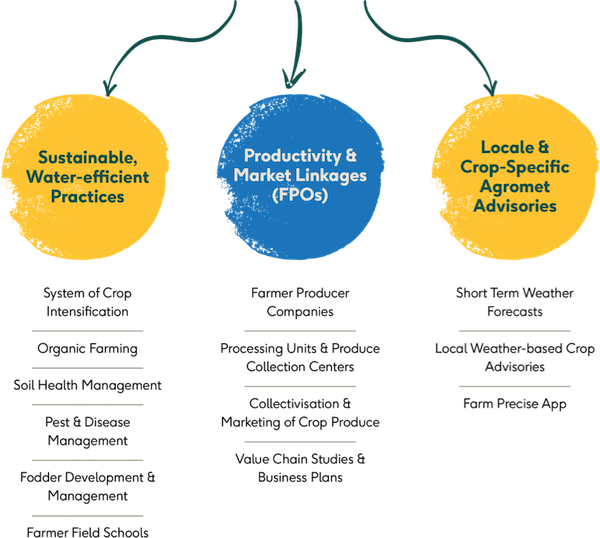
Mobile telecommunications are increasingly being used to deliver weather forecasts directly to farmers in the form of regular advisories. These advisories are also used to introduce farmers to sustainable and innovative agricultural practices that can contribute to improving yields and reducing costs. In this blog we turn to insights from behavioural research to understand how and why advisories can be used to encourage the adoption of sustainable agricultural practices and the implications of this for scaling up these services

Read More »