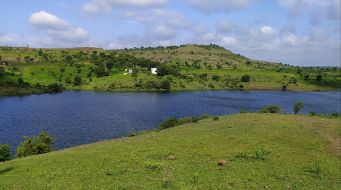
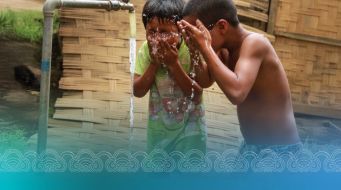
The Kadasi Revenue village in Odisha, which gets water from five springs, provided a closer look at the interplay between nature, community, and water resources to W-CReS researcher Navnath Ghodake during his field visit.
W-CReS researchers’ journey across Maharashtra documenting good O&M practices turned into a travel across diverse terrains and lived realities, with each step testing perception and decision-making
To assess the feasibility of Water Governance Standard and advocate for its integration into programs in Maharashtra related to water resources, a Water Competition (Jal-Spardha) was organised in Dharashiv district.
Water stewardship is a step beyond good water governance that not only ensures quality management and distribution of water, but also builds climate resilient communities.
The Watershed Organisation Trust finds significant alignment between the recommendations by the Global Commission on the Economics of Water’s report and our own Water Stewardship Initiative
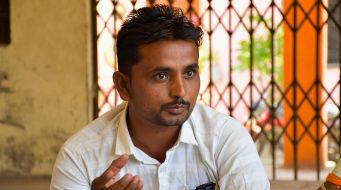
Pandarinath Shinde, a jal sevak with WOTR, helps farmers adapt to climate change by teaching efficient water management and farming practices. He has implemented techniques like micro-irrigation and soil testing on his farm, increasing his income and assisting other farmers in improving their crop yields.
Maharashtra, leads in implementing water harvesting initiatives, with over 99% of its 97,062 water bodies being artificial. W-CReS collaborated with ATE Chandra Foundation to assess the impact of rejuvenation of water bodies five years after implementation.
Borgaon Budruk’s Village Development Committee (VDC) and Village Water Management Teams (VWMT) have successfully addressed water scarcity through community-driven water conservation efforts, significantly improving local conditions.
The Kadasi Revenue village in Odisha, which gets water from five springs, provided a closer look at the interplay between nature, community, and water resources to W-CReS researcher Navnath Ghodake during his field visit.
W-CReS researchers’ journey across Maharashtra documenting good O&M practices turned into a travel across diverse terrains and lived realities, with each step testing perception and decision-making
To assess the feasibility of Water Governance Standard and advocate for its integration into programs in Maharashtra related to water resources, a Water Competition (Jal-Spardha) was organised in Dharashiv district.
Water stewardship is a step beyond good water governance that not only ensures quality management and distribution of water, but also builds climate resilient communities.
The Watershed Organisation Trust finds significant alignment between the recommendations by the Global Commission on the Economics of Water’s report and our own Water Stewardship Initiative
Pandarinath Shinde, a jal sevak with WOTR, helps farmers adapt to climate change by teaching efficient water management and farming practices. He has implemented techniques like micro-irrigation and soil testing on his farm, increasing his income and assisting other farmers in improving their crop yields.
Maharashtra, leads in implementing water harvesting initiatives, with over 99% of its 97,062 water bodies being artificial. W-CReS collaborated with ATE Chandra Foundation to assess the impact of rejuvenation of water bodies five years after implementation.
Borgaon Budruk’s Village Development Committee (VDC) and Village Water Management Teams (VWMT) have successfully addressed water scarcity through community-driven water conservation efforts, significantly improving local conditions.
How planning and implementation of ecosystem-based adaptation (EbA) and agroecology principles in arid or semi-arid regions can help address the growing impacts of climate change.
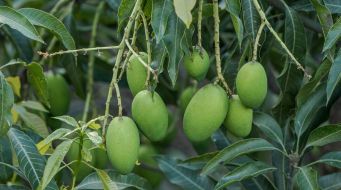
Mango orchards are improving rural livelihoods in Chhattisgarh, creating resilient farms, diverse incomes, and long-term opportunities for farming communities.
Drawing on WOTR’s grassroots experience, this piece explores the powerful connection between water security, ecosystem restoration, agriculture and nutrition security in rural India.