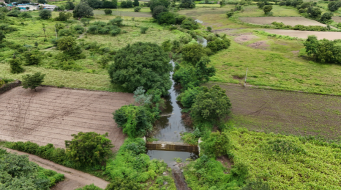
Water budgeting is ‘an estimate of harvest of water resources and its utilization for a set period of time.’
A Better Tomorrow
Stories, Practices, and Solutions
This blog post delves into a comprehensive report, “A Comparative Study of the Water Footprint and Economics of Cashew Cultivation and its Alternatives in Odisha,” which explores the complexities of cashew farming in the eastern Indian state of Odisha.
In Odisha’s Gajapati and Rayagada districts, where water scarcity and erratic rainfall have long posed challenges, the Watershed Organisation Trust (WOTR) implemented a transformative climate resilience project, supported by Andheri Hilfe.
This case study highlights the journey of Eta Bai Rathod from Kangti Mandal, in Sangareddy district, exemplifying how targeted interventions can improve livelihoods through sustainable agricultural practices. Eta Bai’s story illustrates the convergence of water management, crop diversification, and institutional support—strategies critical for addressing India’s agrarian challenges.
In the quest for rural communities to overcome water scarcity and build a resilient future, determination, collaboration, and the right support are essential. For the villages of Phalode and Sawarli, Pimpari in Maharashtra this journey began with a clear vision and collective action.
As we celebrate Women’s Day throughout March, we’re honored to share inspiring stories of women who embody grit, resilience, and determination.
Within a small place, Singaram Budhundu from Telangana and his family members manage a small kitchen garden which provides his family with a steady stream of fruits and vegetables, adds to their nutrition and also boosts the family income
Farmer Producer Companies are strengthening Indian agriculture but face financial and market challenges. WOTR empowers them to boost rural livelihoods and sustainability.
Ecosystem integrity is a holistic approach to conservation that considers the wholeness of entire landscapes and ecosystems rather than focusing solely on individual species or resources
In response to the water woes of India, the Watershed Organisation Trust (WOTR) has introduced the GMI approach. This initiative shifts the paradigm from viewing water as a private asset to a shared resource, fostering collaborative water management.
Water budgeting is ‘an estimate of harvest of water resources and its utilization for a set period of time.’
This blog post delves into a comprehensive report, “A Comparative Study of the Water Footprint and Economics of Cashew Cultivation and its Alternatives in Odisha,” which explores the complexities of cashew farming in the eastern Indian state of Odisha.
In Odisha’s Gajapati and Rayagada districts, where water scarcity and erratic rainfall have long posed challenges, the Watershed Organisation Trust (WOTR) implemented a transformative climate resilience project, supported by Andheri Hilfe.
This case study highlights the journey of Eta Bai Rathod from Kangti Mandal, in Sangareddy district, exemplifying how targeted interventions can improve livelihoods through sustainable agricultural practices. Eta Bai’s story illustrates the convergence of water management, crop diversification, and institutional support—strategies critical for addressing India’s agrarian challenges.
In the quest for rural communities to overcome water scarcity and build a resilient future, determination, collaboration, and the right support are essential. For the villages of Phalode and Sawarli, Pimpari in Maharashtra this journey began with a clear vision and collective action.
As we celebrate Women’s Day throughout March, we’re honored to share inspiring stories of women who embody grit, resilience, and determination.
Within a small place, Singaram Budhundu from Telangana and his family members manage a small kitchen garden which provides his family with a steady stream of fruits and vegetables, adds to their nutrition and also boosts the family income
Farmer Producer Companies are strengthening Indian agriculture but face financial and market challenges. WOTR empowers them to boost rural livelihoods and sustainability.
Ecosystem integrity is a holistic approach to conservation that considers the wholeness of entire landscapes and ecosystems rather than focusing solely on individual species or resources
In response to the water woes of India, the Watershed Organisation Trust (WOTR) has introduced the GMI approach. This initiative shifts the paradigm from viewing water as a private asset to a shared resource, fostering collaborative water management.
By Categories
By Tags
Plant blindness may be biodiversity’s most overlooked threat. Here’s why learning to see plants could change everything for our planet.
Bees sustain our food, ecosystems, and economies. Discover why protecting pollinators is humanity’s most urgent environmental responsibility.
EbA strengthens ecological processes – restoring soil moisture, improving vegetation cover, enhancing water retention, and supporting biodiversity.
Discover how responsible AI innovations can protect ecosystems, empower vulnerable communities, tackle climate change, and support sustainable global development.
Ecohydrology unites ecology and hydrology to transform water management. Discover how it drives sustainability, ecosystem health, and resilient communities.
Sindhu’s 15-year journey reveals how widow property rights remain unclaimed without awareness, community support, and institutional guidance in rural India.
Capacity Building as a cornerstone of rural development strengthens leadership, resilience, sustainability, and community-driven solutions through inclusive training initiatives.
Participatory systems thinking empowers community-led development by integrating local knowledge, strengthening resilience, sustainability, and enabling adaptive, inclusive, long-term rural solutions.